Tell us about the work you would like to simplify or create.
Based in South Florida. Remote delivery across the United States.
We’ll discuss the task, your existing tools, and what a useful first project could look like. After your enquiry, we’ll reply by email to arrange the next step.
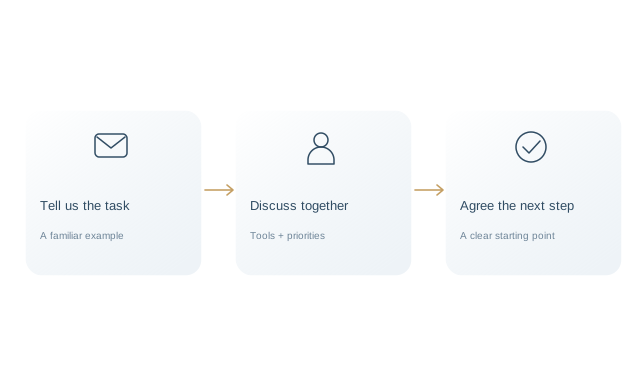
Share a task. Find the next step.Enquiry → conversation → agreed starting point
Helpful to include: the task, tools you use, and where your team needs to stay involved. A short description is enough.
Your first conversation
30 minutes. Free. Focused on one task.
Request an introductory call through the form. We reply by email to agree a time; submitting the form does not reserve a calendar slot.
05 MINUTES
Your goal
What would you like your team to spend less time on?
10 MINUTES
The current workflow
Walk through the tools, inputs and people involved.
10 MINUTES
Fit and possible approach
Discuss suitability, constraints and a sensible pilot boundary.
05 MINUTES
A clear next step
Agree what information is needed and whether discovery makes sense.
You leave with a proposed starting point, the main questions to resolve and a possible next step. A detailed audit or implementation is scoped separately.
Questions & answers
From finding the opportunity to running the solution independently. Choose a topic and open a question.
Where AI can help
I don’t know where AI could help my company. Can you help us find out?+
Yes. We look at how your work is organised: the tasks involved, who takes part, the tools your team uses and where time is lost. We identify specific points where AI can speed up work, improve the result or reduce costs. You receive a clear explanation of what to change, how it would work and why it matters to your business.
Is AI only useful for automating routine tasks?+
No. AI can support different stages of work: research, idea generation, information analysis, proposal preparation, material creation and result checking. Sometimes the most useful solution is giving an employee the right AI tool and teaching them how to use it in everyday work.
How do you decide exactly where to add AI?+
We examine the process step by step: where information comes from, how decisions are made, what is produced and who checks the result. For each stage, we assess how AI could help, what data it needs and where human involvement is essential. We then choose changes with the clearest practical value.
Can you improve work we already do with AI?+
Yes. We can review your existing tools, instructions and ways of working: where people spend time repeating prompts, moving results manually or dealing with inconsistent quality. We suggest how to improve inputs, set up checks, connect tools and make a successful approach available across the team.
Results & costs
Can automation reduce staffing costs?+
Yes. It can take on some repetitive responsibilities and reduce the working hours a process requires. That can help redistribute workload, postpone additional hiring and, in some cases, reduce the need for particular positions. Whether a whole role can be replaced depends on its responsibilities. We assess the actual work rather than promise that in advance.
What results can we expect?+
The main outcomes are less manual work, faster task completion, more consistent quality and the ability to handle greater volume with your existing team. Before implementation, we select project measures such as time spent, response speed, processing cost, corrections or tasks completed. After launch, we compare them with the baseline.
Can we start with one task?+
Yes. You can choose a single process or one stage of an employee’s work, such as preparing proposals, handling incoming enquiries or creating a report. This lets you test the approach within a limited scope and decide what makes sense to implement next.
What does implementation cost, and what will we pay for monthly?+
The cost depends on task complexity, the number of connections and the amount of work involved. Before starting, we separately identify implementation, training and handoff, along with potential recurring costs: subscriptions, AI usage, infrastructure and support. You understand the total cost before deciding.
Tools & security
Will we have to change the software we already use?+
We start by reviewing your current tools and their integration options. Where needed, we suggest additional services. Before work begins, we explain what will change for employees and what new costs may arise.
How do you protect company data?+
Before connecting systems, we agree what data the solution needs, where it will be processed, how it will be stored and who will have access. We select services with your company’s requirements in mind and limit permissions to the necessary actions. Confidentiality and data-handling terms are agreed before implementation begins.
Could AI send information to the wrong person or take an unwanted action?+
To reduce that risk, we define allowed recipients, accessible data and permitted actions in advance. Sensitive operations require employee approval. You can start in a mode where AI only prepares drafts and recommendations, while a person sends messages and performs other significant actions.
What happens if AI makes a mistake or the system stops working?+
Checks and exception handling are part of process design. We define which results need review, when the system should stop and who should take over the task. For important workflows, we agree on failure notifications and a fallback procedure. Ongoing monitoring and support terms are discussed separately.
Your team & life after launch
What if our employees cannot use the solution?+
During development, we consider who will use the system and what level of complexity is appropriate for that team. We provide instructions and training on real tasks. Before handoff, we check that employees can perform the main actions, review results and ask for help.
Will this require even more of my attention as a business leader?+
At the start, you or a responsible employee will need to help define the task, provide the necessary context and agree on the result. We then organise the workflow so everyday actions are handled by the system and your team, while you receive a clear view of results and notifications about important exceptions.
What happens after launch? Can we use the solution independently?+
Before the project starts, we agree who owns the accounts and development outputs, which access rights and instructions are handed over to your company, and who is responsible for ongoing operation. We can include support and improvements if needed. If the solution is handed over to your team, we define in advance what knowledge and resources independent use will require.